






Table of Contents
ToggleShrivelfig fruit is one of Hogwarts Legacy’s most underrated yet essential resources. Whether you’re grinding potions for battle or chasing down specific quest requirements, knowing how to locate, cultivate, and use shrivelfig fruit can significantly streamline your gameplay. This guide breaks down everything, exact locations, farming routes, greenhouse cultivation, crafting recipes, and strategy tips, so you can stop wandering aimlessly through the castle grounds. By the end, you’ll have a complete roadmap for mastering this rare ingredient and keeping your potion supply consistently stocked.
Key Takeaways
- Shrivelfig fruit spawns consistently at North Hogsmeade, Upper Hogsmeade Valley, and Hogwarts Grounds East Wing, with respawn cycles occurring every 30 minutes of in-game time.
- Growing shrivelfig in your greenhouse is a mid-to-late game quality-of-life upgrade that removes farming route dependency and provides steady ingredient supply.
- Shrivelfig fruit combines with other ingredients to create essential potions like Bundimun Sting and Cure for Boils, with potion yield scaling from 1-3 doses based on your Potions proficiency level.
- The optimal farming route cycles through three locations in 15-20 minutes, yielding 30-40 shrivelfig fruits per hour while avoiding common mistakes like inventory overflow and unnecessary combat.
- Story quests and character questlines occasionally require shrivelfig as proof of potion-making skill, making stockpile management key to maintaining quest momentum.
- Mastering shrivelfig resource management transforms Hogwarts Legacy gameplay from reactive ingredient scrambling into proactive preparation, enabling consistent access to combat potions and progression support.
What Is Shrivelfig Fruit?
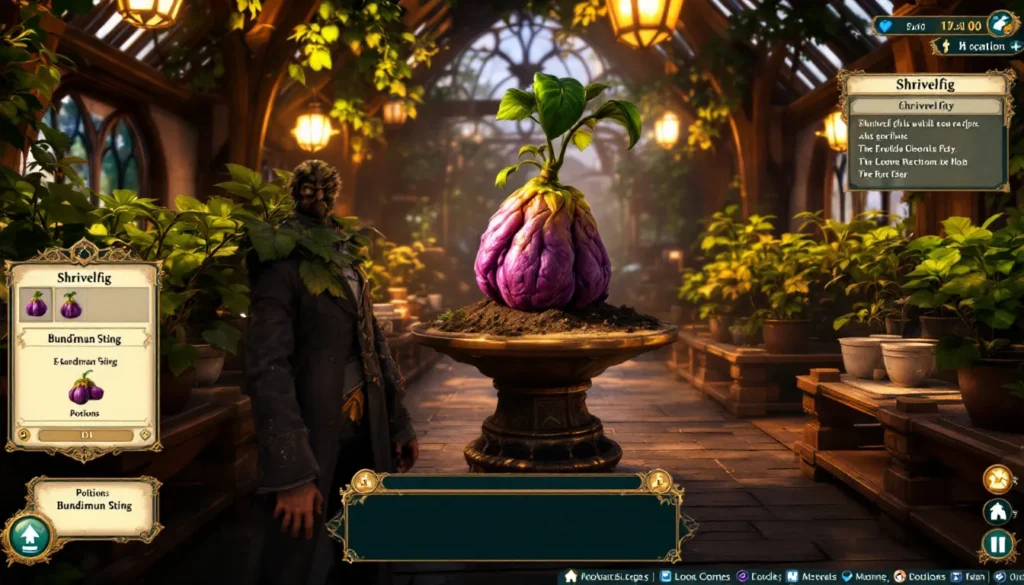
Shrivelfig is a magical plant ingredient found throughout Hogwarts Legacy that plays a crucial role in potion-making and quest progression. The fruit itself is a wrinkled, purple-tinged ingredient that wizards have valued for centuries. In the game, it’s classified as a standard ingredient, meaning it’s not ultra-rare like some endgame materials, but it’s definitely more exclusive than common items you’ll stumble upon constantly.
You’ll encounter shrivelfig fruit for the first time during early-game exploration, but the real grind starts once you begin serious potion crafting. The ingredient is needed for multiple brewing recipes that have practical applications, both for combat potions and story progression. Understanding its properties helps you prioritize when and where to farm it.
The fruit grows naturally on shrivelfig plants, which are distinctive-looking vegetation scattered across Hogwarts and the surrounding regions. The plants are visually recognizable once you know what you’re looking for: they’re compact, dark-colored, and notably different from other foliage. Harvesting yields the fruit itself, which you’ll add to your inventory for future use.
Where to Find Shrivelfig Fruit
Shrivelfig plants spawn across multiple locations in Hogwarts Legacy, but some spots are far more abundant than others. The key to efficient collection is knowing exactly where these clusters form and how the respawn system works.
Location Details and Map Markers
The most reliable shrivelfig locations are found in these zones:
- North of Hogsmeade: A consistent spawning area with 3-4 plants clustered together. Fast travel to the Hogsmeade Town Entrance and head north, you can’t miss them once you get familiar with the layout.
- Upper Hogsmeade Valley: Near the crossing bridge, there’s a secondary cluster of shrivelfig plants. This area tends to respawn quickly, making it excellent for repeat runs.
- Hogwarts Grounds (East Wing): Behind the castle, particularly near water features, shrivelfig plants grow in patches. The exact spots are marked on your map once you’ve discovered them.
- Forbidden Forest perimeter: The outer edges of the Forbidden Forest hold a few shrivelfig plants, though venturing into the forest proper brings greater danger with minimal reward for this specific ingredient.
Once you’ve harvested from a location and left the area, returning later will cause the plants to respawn. The map is your best friend, place markers at the reliable spawn points so you can execute fast farming runs without confusion.
Respawn Rates and Collection Tips
Shrivelfig plants respawn on a time-based cycle, typically every 30 minutes of in-game time. This means you can complete multiple runs through the same locations, but you’ll need to move to a different zone and return for the respawn to trigger. Don’t waste time sitting idle in one spot hoping for regrowth, it won’t happen without changing your location.
Here’s the optimal approach: Hit your primary spawn location (North of Hogsmeade), harvest 3-4 fruits, then fast travel to the Upper Hogsmeade Valley location. By the time you finish that secondary run, enough time has passed that your first location will have respawned. This creates a smooth, cycle-based farming loop.
Bring a spriggan creature if you have one unlocked, these magical companions can occasionally help with resource gathering. More importantly, wear gear that boosts gathering speed or ingredient yield if available. Even small percentage increases compound when you’re doing multiple runs. Finally, check your beastiary and notes: the game sometimes provides hints about ingredient locations tied to specific creatures or story moments. For additional insights on exploring Hogwarts’ hidden areas, the Hogwarts Legacy Archives offers comprehensive regional breakdowns that can supplement your harvesting runs.
How to Grow Shrivelfig in Your Greenhouse
Growing your own shrivelfig fruit in the greenhouse removes reliance on map exploration and farming routes. Once you unlock greenhouse access, which happens through the Room of Requirement expansion, you can cultivate shrivelfig plants directly. This is a massive quality-of-life upgrade for mid-to-late game players.
Greenhouse Seed Requirements
To grow shrivelfig, you’ll need shrivelfig seeds first. Seeds are obtained differently than harvested fruit. You can find them through various means:
- Loot from defeating enemies: Certain enemy types drop seeds when defeated, particularly dark wizards or creatures that frequent potion-crafting areas.
- Purchase from merchants: The Hogsmeade apothecary will sell seeds once your Merlin Trials progress unlocks premium ingredients.
- Rare map discoveries: Breaking barrels, chests, and destructible objects occasionally yields seeds, this is more hit-or-miss but can supplement your supply.
Once you have seeds, entering the greenhouse is straightforward. You’ll interact with a planting station and select which ingredient you want to cultivate. The UI clearly shows requirements and growth times, so there’s no guesswork involved.
Growth Time and Care Instructions
Shrivelfig takes approximately 2-3 in-game days to mature from seed to harvestable fruit. That’s notably faster than some rare ingredients, making shrivelfig one of the more accessible greenhouse options. During the growth period, the plant requires standard care, water when prompted and ensure it has adequate sunlight (the greenhouse handles most of this automatically unless you’ve customized your setup).
You don’t need to babysit the plant constantly. Check back periodically, perform any maintenance actions the UI suggests, and move on. The game is forgiving about neglect, shrivelfig plants won’t die from minor oversights, though they’ll grow slower if you ignore them completely. Once matured, harvest immediately to free up space for your next batch. With efficient cycling, you can maintain a steady stream of fresh shrivelfig fruit without ever stepping foot outside the castle. This method pairs exceptionally well with crafting, since you’ll harvest and immediately brew. For broader strategies on resource management, reviewing Hogwarts Legacy Spell Combos can help you coordinate potion use alongside your crafting schedule.
Crafting Recipes and Potions Using Shrivelfig
Shrivelfig fruit is a versatile ingredient in multiple potion recipes, each with specific applications in combat and exploration.
Essential Potions and Brews
The most notable recipes include:
- Bundimun Sting: A dark-themed potion combining shrivelfig with bundimun secretions. This brew increases poison damage output for 30 seconds, making it essential for dark wizard confrontations.
- Cure for Boils: A healing-oriented potion featuring shrivelfig as a key component. When consumed, it removes debuffs and restores health, useful during extended dungeon runs or boss fights.
- Intelligence Draught: A cognitive enhancement potion that boosts spell accuracy and critical hit chance. Shrivelfig serves as the stabilizing ingredient that prevents the potion from destabilizing.
Each recipe produces 1-3 doses depending on your potion-making proficiency and ingredient quality. Higher proficiency levels yield more doses per batch, making ingredient management increasingly efficient as you level up your Potions skill.
Ingredient Combinations and Yield
Understanding yield is crucial for efficient farming. A basic Bundimun Sting requires 1 shrivelfig fruit + 1 bundimun secretion + 1 peppermint sprig. If you have high proficiency, you’ll get 2-3 potions from that single batch. This scaling makes proficiency investment worthwhile, you’ll stretch fewer raw ingredients further.
The yield breakdown typically follows this pattern:
- Proficiency 1-3: 1 dose per craft
- Proficiency 4-6: 2 doses per craft
- Proficiency 7+: 3 doses per craft (sometimes 4 with rare RNG)
Stock management becomes easier when you recognize these thresholds. Aim to hit proficiency tier breakpoints, then farm shrivelfig accordingly. If you’re at proficiency 6 and about to push to 7, you can use fewer shrivelfig fruits going forward because your yield will jump.
According to resources like GameRant’s Hogwarts Legacy guides, players often find that front-loading potion ingredients early game, including shrivelfig, saves enormous amounts of time during mid-game progression. Having a stockpile of basic potions eliminates the need for emergency crafting during difficult encounters. The strategy of combining farming runs with greenhouse cultivation means you’ll rarely face ingredient shortages, letting you focus on actually playing rather than managing inventory stress.
Shrivelfig Quest Locations and Story Integration
Shrivelfig fruit appears in specific story quests and character questlines, not just as a crafting ingredient. Understanding these moments helps contextualize the resource within Hogwarts Legacy’s narrative and can guide your preparation.
Several relationship-building quests with characters involve gathering shrivelfig as a demonstration of your potion-making skill. These are typically low-pressure requests where an NPC asks you to bring them a shrivelfig fruit (or a potion containing it) as proof of your capabilities. Having these ingredients on hand prevents backtracking and maintains quest flow momentum.
There’s also a specific quest tied to greenhouse unlocks that explicitly requires shrivelfig collection. This serves as an early tutorial for the farming/harvesting loop the game expects you to master. Pay attention during this quest, it teaches respawn mechanics and efficient gathering, lessons directly applicable to your future ingredient runs.
Also, certain creature companions have dialogue or interactions triggered by holding shrivelfig. This is flavor content, but it reinforces that ingredients have meaning beyond raw mechanics. The developers put thought into why these items matter within the world. When you understand the story context, that shrivelfigs have historical significance in potions and dark magic, collecting them feels less like grinding and more like authentic magical practice.
For a broader look at character relationships and questlines, exploring how How to Open Eye Chest Hogwarts Legacy reveals hidden story beats can help you appreciate the narrative depth woven throughout ingredient-gathering moments.
Farming Strategies for Maximum Efficiency
Shrivelfig farming becomes exponentially more efficient once you develop a systematic approach rather than random collection.
Best Farming Routes
The optimal route depends on your current game state, but this sequence works for most players:
- Fast travel to Hogsmeade Town Entrance (sets your starting point).
- Head north to the primary North Hogsmeade cluster (4 plants, ~2 minutes to harvest).
- Fast travel to Upper Hogsmeade Valley (respawn timer is now ticking on location 1).
- Harvest the secondary cluster (2-3 plants, ~90 seconds).
- Travel to Hogwarts Grounds East Wing (visit the water-adjacent spawn point, ~3 plants, 2-3 minutes).
- Fast travel back to Hogsmeade Town Entrance and repeat (approximately 15-20 minutes total cycle time nets 9-11 shrivelfig fruits).
This route yields approximately 30-40 shrivelfig fruits per hour of active farming, assuming you’re not distracted by combat or other encounters. That’s enough to sustain most players’ crafting habits indefinitely.
Document your exact route on the map by placing markers at each cluster. Treat it like a circuit, enter, harvest, move to next marker, repeat. Don’t deviate to explore or fight unless absolutely necessary. Efficiency comes from consistency and minimizing travel time.
Common Mistakes to Avoid
Farmers often sabotage their own efficiency through preventable mistakes:
- Overshooting inventory capacity: You have a max carrying capacity. If you’re full on ingredients, you can’t pick up more. Check your inventory before each route segment.
- Forgetting the respawn timer: Standing in one location won’t trigger regrowth. You must leave and return. Always move between locations, don’t camp one spawn point.
- Ignoring proficiency boosts: If you have gear or perks that boost gathering yield, equip them before farming. A 10% boost might not sound huge, but it adds up across 50+ harvests.
- Harvesting at the wrong time of day: Some plants respawn faster during specific in-game times. Test different times and note which yields the quickest regrowth cycles.
- Fighting unnecessary enemies: Every encounter costs time. If you can bypass hostile creatures, do it. Shrivelfig farming is about speed, not combat.
- Not unlocking the greenhouse early enough: Greenhouse access removes reliance on map farming entirely for late-game players. Prioritize Room of Requirement expansion once available.
Most experienced players combine two strategies: Early game emphasizes map farming while you unlock greenhouse access, then mid-to-late game transitions to greenhouse cultivation with occasional map runs for supplemental supply. This hybrid approach is the highest-efficiency long-term solution.
For additional optimization tips on inventory management and movement mechanics, consulting resources like Shacknews Hogwarts Legacy guides reveals advanced techniques that serious players use to squeeze extra farming efficiency. Some techniques involve specific spell combinations or creature abilities that accelerate gathering. Meanwhile, the Mooncalf guide touches on companion abilities that can boost ingredient collection, a synergy worth exploring for your full farming toolkit.
Conclusion
Shrivelfig fruit is far more than a random ingredient, it’s a cornerstone of Hogwarts Legacy’s resource economy that affects everything from combat viability to progression pacing. Mastering where to find it, how to cultivate it, and which potions require it transforms your gameplay from reactive scrambling to proactive preparation.
Start with the map locations outlined here, establish your farming route, and maintain consistent runs until greenhouse access unlocks. Once you’re cultivating shrivelfig in the Room of Requirement, ingredient anxiety largely disappears. You’ll always have what you need for important potions, never derailing your adventure to hunt resources.
The players who thrive in Hogwarts Legacy aren’t necessarily the ones pulling off fancy spell combos, though that helps, but rather those who maintain their supply chains and approach challenges properly equipped. Shrivelfig abundance supports that entire foundation. Apply these strategies, and you’ll join that competent player tier where magical resources feel abundant rather than scarce.